Good Stewardship Of Resources

美佳之窗 His Window 111( Jul - Sep 2025 )主流话题
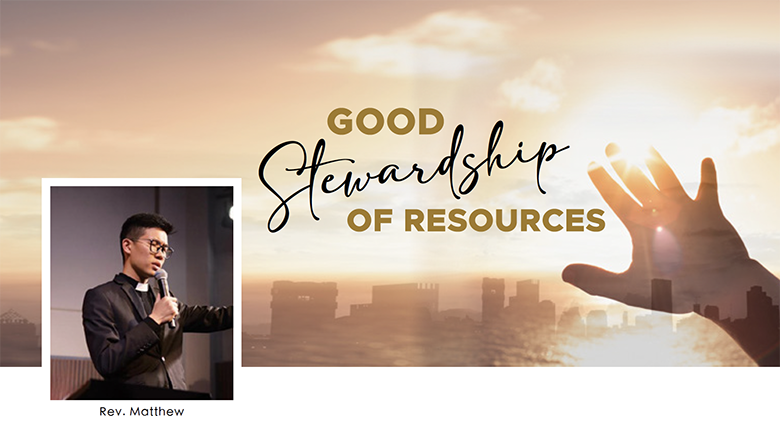
Text by Rev. Matthew
In today’s times, financial literacy has become a priority for most people. Turbulent economies coupled with the rising cost of living has made most people prudent when it comes to spending. This is no foreign concept for the Christian. We are called to be stewards of all that God has given to us. And Christian stewardship is not merely isolated to finances, it extends to everything — health (mental and physical), family and relationships. As the church teaches good stewardship, it must also set the example of being a good steward herself. In this article, we will explore key elements of stewardship that are crucial in order to maintain a healthy church.
Why: Building a Sustainable Church
Before we dive into what stewardship looks like, we must understand why we need good stewardship. In a nutshell, good stewardship builds a sustainable church. Imagine this scenario: a church experiences a boost in growth — physical numbers and finances. Said church begins to spend on a bigger building to accommodate the growing crowds. A bigger congregation and building means, bigger staff team to maintain the worshippers, run ministries, and maintain the facilities. These general increases — staffing, building, ministries — all contribute to a general increase in expenditure. One may argue that such an improvement in facilities will certainly attribute to an increase in tithes and offerings — the sole income for the church. However, as the years go by, said church experiences some challenges. First, “competition” from a nearby church has pulled around 20% of its worshippers away from their church. Secondly, a financial crisis hit the country and most worshippers are feeling the pinch of inflation, hence, a reduction in offering and tithes. Third, the intention to maintain and grow the attendance has put the church into overdrive mode in the area of running activities that attract people, but, its effect is generally waning. And while precious resources are spent on these activities, its returns do not match the investment poured in. What we get here is a short, summarised picture of an unsustainable church.

Building a sustainable church is not just about an eco-friendly church. We need to look at sustainability through various lens. Are we building a financially sustainable church? Are we building sustainable ministries? Are we building sustainable Christians, not “church hopping” Christians? Are we building sustainable ministry teams? Sustainability is the goal of stewardship and if we can look into different aspects of church ministries, personnel and worshippers, we can be on the right path towards building a sustainable church.
How: Financial Stewardship
Right at the very top is the element of financial stewardship. The main “income” of the church comes from its tithes and offerings. And the amount varies from church to church, depending on its size and makeup of the church. A church that is big and has a higher income worshipper base will undoubtedly have a higher income, compared to a smaller church in a rural town. When speaking of financial stewardship while there are verses that teach us that, I think the best principle, coming from a Methodist background is to look at John Wesley’s threefold principle of financial stewardship. John Wesley is known for saying this: earn all you can, save all you can and give all you can.
The church must preach the importance of giving offering. But, the church cannot force its members to give offering. Giving of tithes and offering is biblical and though a difficult topic to teach, it must be taught. Pastors should not approach this topic from the angle of the needs of the church, rather approach it from the angle of worship. The giving of offering is a twofold act of worship. First, it reminds us of the “offering” of Christ for our sins, giving us what we did not deserve. Secondly, as we give, it is a reminder to give our life to Christ on a daily basis. The offering is so much more than just placing our money in the offering box, or in today’s times, scanning a QR code and transferring an amount. It is a visual and practical act that informs us about the theology of salvation and our appropriate response. If the church can provide clearer teaching about offering to its worshippers, it will bring about education that will encourage them to see the greater purpose of giving an offering. As the church does this, it is “earning” its keep. But, offering given must be “saved.” Some churches undoubtedly have to spend all that they receive in that week on operational expenses. However, it is always a good practise to save up for rainy days ahead, where possible. The church must know how to save up money for future use. The church must avoid wasting unnecessary funds on building better and fancier buildings. The church must avoid excessive spending on ministry needs if there isn’t a clear reason to do so. The church must always be transparent and accountable for every penny coming in and going out of its bank account. To save up is biblical, to be prudent in spending makes us a good steward of the financial resources God has given to the church.

Offering “saved” must be “given” as well. In John Wesley’s context, he believed that above all, the church must be a church that knows how to meet the needs of society. The epistle of James 2:16 reminds Christians to be relevant, especially in a world that is hungry and dying. The church must learn how to use its funds not for itself first, but, for others. Financial stewardship involves unselfish usage of church money to help the poor and needy. Financial stewardship should involve allocating budget to help smaller churches in need. When we can do so, we are not just speaking and teaching about Christ’s love, we are embodying Christ’s love.
How: Ministry Stewardship
Another way the church can practise stewardship is in the area of ministry. Ministry stewardship is the concept of placing emphasis on ministries that are aligned with the vision and mission of the church. It is also the practise of running and setting up ministries in moderation. Lastly, ministry stewardship is to ensure that both the ministry teams and volunteers are not burnt out by the work load of the ministry.
Speaking of ministries, it is imperative that the church first recognises the direction it is heading. Running or planning ministry programmes without a specific direction is akin to a ship without a heading — you will end up nowhere. Before any ministry or activity planning is done, it is important that the church leadership sits down and asks themselves 2 very important questions: What is our long-term vision? What is our short-term vision? The long-term vision is the big picture of where the church needs to get to, while the short-term vision are the building blocks that make up the long-term vision. In terms of time frame, a long-term vision would be the vision 10 years ahead, while the short-term vision can be achievable within a year. A church with a clear purpose and vision will be a church that is intentional and purposeful in their ministries. When ministries and activities are planned with a vision and direction in mind, these ministries will then serve its purpose to build up the spiritual lives of the worshippers. It will not be burdensome activities, nor will the church simply be an activity-churning machine. The church will be a spiritual institution where people come and are fed.
Ministry stewardship ensures that each individual ministry activities are kept in moderation. An important question to ask ourselves as ministry leaders is this: are my ministry activities taking people away from their personal time with God, family and friends? Rethinking church ministries is important if we want to maintain volunteers and worshippers who are zealous to serve God. A church that only focuses on increasing its activities per year, will soon realise that worshippers will gradually feel fatigued, and stop attending these events altogether. It is also important to recognise that sometimes, the concept of “less is more” works best for the church. The church must not attempt to fulfil every aspect of the Christian’s life, nor should it even attempt to “intrude” into every spare moment of the Christian’s life. We exist for the spiritual nourishment of believers, let us keep it at that. The church must recognise that the primary elements of church life is worship, learning of the Word, fellowship, and communion (breaking of bread). Everything else is secondary. If the secondary elements seep and take people away from the primary elements, then something is not right, and we probably need a restructuring of church activities. In doing so, our volunteers will not be burnt out, instead will grow through serving and being part of the church ministries.

What’s Next?
Revelation 2:29 says, “He who has an ear, let him hear what the Spirit says to the churches.” This is a message that repeatedly appears in Jesus’ message to the seven churches. It is a call to listen, to receive what the Holy Spirit is saying, to repent, and change what needs to be changed. This calling is also our calling today. Churches must seek to be good stewards of the resources and people God has given to us. Churches must reclaim their original purpose of existence and seek to build God’s kingdom, not their own. Churches must press on to be “Salt and light” in the community and not hide their lamp under a cover. The church must be practical and transformative and this starts and ends with good stewardship.


